Oh Laude-y!
It's a big club, and you ain't in it.
Virtually all scientists would agree that the most frustrating thing about applying for grants is that you often don’t get them. So what if there was another way? Get ready to learn about Moonshots.
Flying under the banner of “Metascience”, there’s been a flurry of initiatives to improve the grant-making process. On paper this sounds great; funding processes can be remarkably inefficient1. Imagine your postdoctoral fellowship covers a year of salary and gets 300 applicants, each of whom spends a day on it. If the research time spent applying exceeds the research time supported, you’d do more for science setting the money on fire. There are a host of other concerns, from bias2 and cumulative advantage3 to the difficulty of funding risky research4. You’ll find few scientists who think the current system of obtaining funding is just fine as is.
Moonshots
Leveraging this appetite, the NSF’s new approach to create an ostensible golden age of science calls for “innovative models for funding and sharing research”. I’ve been a pretty vocal opponent of Gold Standard science, arguing in the past that it’s a wolf in sheep’s clothing metascientists should have seen coming. If you ring the “science is broken” bell loud enough, don’t be surprised if the bad guys come to the table. And they have, as we’ll see below.
One of the first clear examples I’ve seen is the Moonshots programme which kicks in $17.25M of taxpayer money alongside tech money to something called the Laude Institute. Laude was launched by Andy Konwinski, a venture capitalist at Laude Ventures and co-founder of tech companies Databricks and Perplexity.
Laude’s Moonshots program has an ostensibly innovative design. Their plan? A committee selects eight teams for $250,000 seed grants, giving them six months to develop their projects and compete for a $10 million, multi-year funding round. There’s even a Demo Day. This looks less like innovative scientific funding and more like: “What if we ran science like a startup accelerator?”
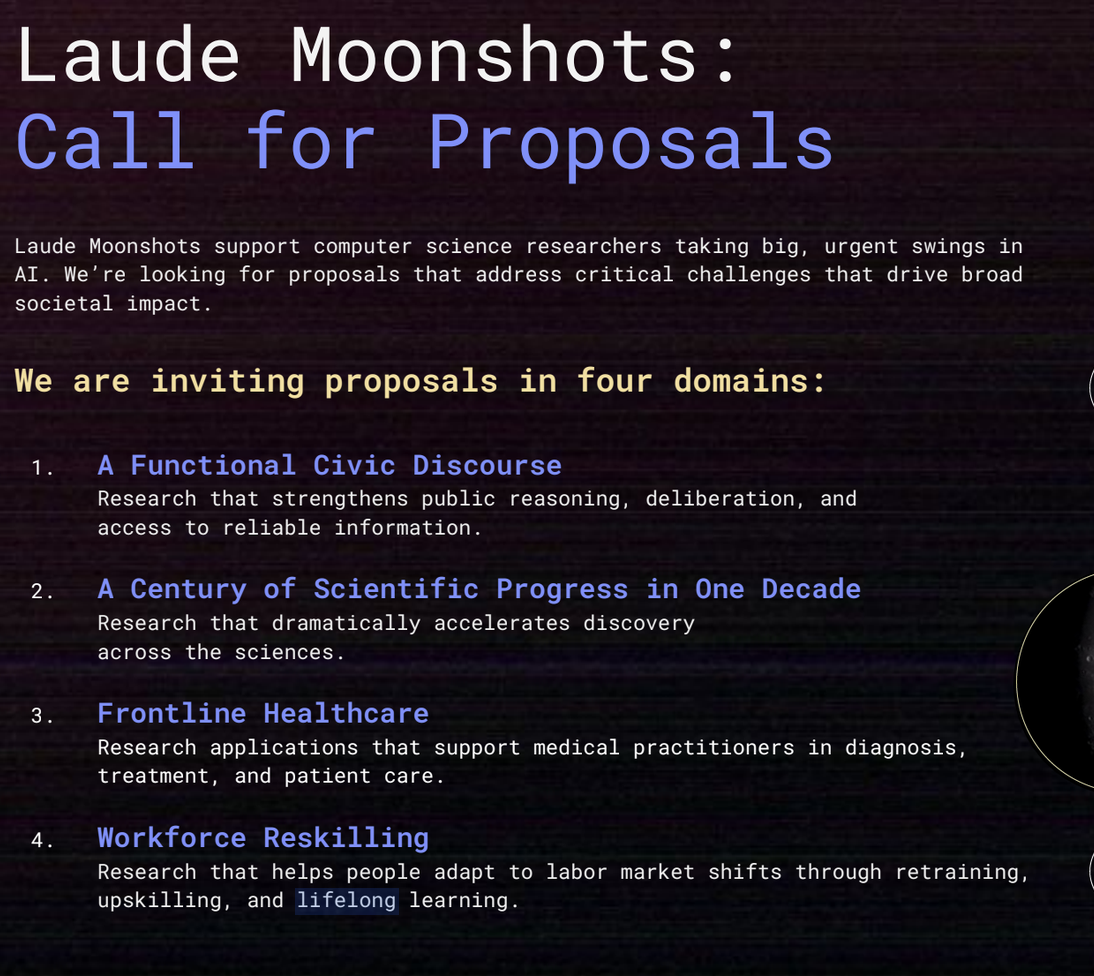
It’s also important to notice the topical bias towards industry-preferred research. For example, one of the acceptable topics is “Workforce Reskilling”, which tacitly assumes that AI will take all of our jobs. This is the very same area that Anthropic is dumping $200M into.
The Committee
I don’t know a ton about Konwinski’s beliefs, but the selection committee is a veritable Who’s Who of the pages of Nature, Science, and PNAS, as well as regular attendees at effective altruism, doomer, AI safety meetings. Here’s the list:
Tech
- Andy Konwinski — Laude; co-founder, Databricks; co-founder, Perplexity
- Braden Hancock — Laude; co-founder, Snorkel
- Chris Rytting — Laude; AI researcher; language model evaluation
- Dave Patterson (chair) — Laude; Turing Award laureate; Professor Emeritus, UC Berkeley; Google
- Eric Horvitz — Chief Scientific Officer, Microsoft
- Jeff Dean — Google DeepMind/AI
- John Hennessy — Turing Award laureate; Alphabet Chair; President Emeritus, Stanford
- John Jumper — Nobel laureate; AlphaFold lead researcher, DeepMind
- Thomas Wolf — Co-founder and Chief Science Officer, Hugging Face
Academics
- Adam Yala — UC Berkeley and UCSF; AI and health
- Ameet Talwalkar — Professor, Carnegie Mellon; co-founder, Determined AI
- Chris Bail — Professor, Duke; computational social science
- David Autor — Professor, MIT Economics
- David Rand — Professor, Cornell; behavioral science
- Diyi Yang — Professor, Stanford; NLP
- Erik Brynjolfsson — Professor, Stanford; digital economy
- Gillian Hadfield — Professor, Johns Hopkins; AI alignment and governance
- Hanna Hajishirzi — Professor, University of Washington; NLP; Ai2
- Isaac Kohane — Chair of Biomedical Informatics, Harvard Medical School
- James Zou — Professor, Stanford; ML and computational biology
- Michiel Bakker — MIT and Google DeepMind; AI alignment and collective decision-making
- Sylvia Plevritis — Professor, Stanford; Stanford Cancer Institute
- Tom Mitchell — Professor, Carnegie Mellon; machine learning
- Ethan Mollick — Professor, Wharton; innovation and entrepreneurship
- Yejin Choi — Professor, Stanford; AI researcher and MacArthur Fellow
Policy and nonprofits
- Tino Cuéllar — Laude advisor; president, Carnegie Endowment for International Peace; former California Supreme Court justice.
- Tom Kalil — Former White House technology and innovation advisor
My team has published on the mechanisms by which industry can bias tech research. One of the key ways is through a process called industrial selection5: companies don’t need to corrupt researchers; they can simply select the scientists and topics that align best with their interests. For example, the sugar industry might support earnest scientists studying links between exercise and obesity.
Against this backdrop, it is strange to see around 44 million dollars across both rounds—including $17.25M in taxpayer money—handed through a program of tech industry luminaries and scientists who nearly all received tech funding in the past. As a point of reference, NSF spent just $95 million this year.
The Winners
It seems like stiff competition. Overall, the competition had “125 proposals from 600 researchers across 47 institutions - virtually every top computer science department in the U.S. and Canada. Fields Medalists, Nobel laureates, and Turing Award recipients pointing their best thinking at problems that matter to everyone.” The slate was so good that in addition to the eight round one winners, seventeen grants were given out to other groups.
Let’s look at the committee, removing the emeritus faculty members, tech CEOs, and directors of various organizations… just focusing on the committee members who were likely to have applied for the grant themselves:
Winners — $250,000 team awards
- Michiel Bakker — MIT and Google DeepMind; AI alignment and collective decision-making.
- Diyi Yang — Stanford; natural language processing.
- Erik Brynjolfsson — Stanford; digital economy.
- David Rand — Cornell; behavioral science.
- James Zou — Stanford; machine learning and computational biology.
Runners-up — $200,000 team awards
- Gillian Hadfield — Johns Hopkins; AI alignment and governance.
- James Zou — Stanford; Paper2Agent, a separate team from his $250,000 Virtual Embryo award.
Honorable mentions — $100,000 team awards
- Yejin Choi — Stanford; AI researcher and MacArthur Fellow.
- Chris Bail — Duke; computational social science.
Other academic committee members
- Adam Yala — UC Berkeley and UCSF; AI and health.
- David Autor — MIT; labor economics.
- Sylvia Plevritis — Stanford; biomedical data science and cancer research.
- Tom Mitchell — Carnegie Mellon; machine learning.
- Ethan Mollick — Wharton; innovation and entrepreneurship.
Wait, what? One of the innovations here seems to be that committee members are welcome to win. They cleaned house. Of the thirteen academics listed above, eight were on teams that received funding in round one. Hell, James Zou won TWICE. Separately, Laude funded four runners-up and thirteen honorable mentions, bringing the total to twenty-five funded teams. Those seventeen additional teams received smaller seed grants outside the eight-team lab competition.
The Big Door Prize(s)
According to Laude, NSF joined the program after the eight finalists had already been selected. The federal contribution—$17.25 million—supported the subsequent lab-funding stage. Note that eligibility for those partially taxpayer-funded awards was limited to the eight teams selected through Laude’s earlier competition. Overall, four of those eight teams included members of the initial selection committee. Final judging was conducted by a separate five-person panel, fortunately none of whom were on the competing teams.
Overall, four projects won $10M grants. Here they are with their team members. I’ve bolded members of the initial selection committee:
-
Collaborative Intelligence for the Future of Work — Stanford; $10M. Team: Diyi Yang, Tatsunori Hashimoto, Chris Piech, and Erik Brynjolfsson.
-
Rebuilding Trust in Civic Discourse — Cornell; $10M. Team: Cristian Danescu-Niculescu-Mizil, Natalie Bazarova, Jon Kleinberg, Robert Kleinberg, Mor Naaman, and David Rand.
-
JupyterHealth — UCSF and UC Berkeley; $10M. Team: Ida Sim, Ahmed Alaa, Irene Chen, Jessilyn Dunn, Sandeep Kishore, Fernando Pérez, Maya Petersen, and JP Pollak.
-
Actionable AI Weather Forecasts for Developing Economies — University of Chicago; $10M. Team: Rebecca Willett, Ian Foster, Pedram Hassanzadeh, and Michael Kremer.
Sources: Final lab awards and team members; project titles and initial selection committee.
Two of the final four teams had members on the initial selection committee. For the third, JupyterHealth, a little googling reveals that co-PI Ahmed Alaa has co-authored papers with three committee members: Braden Hancock and James Zou, and Adam Yala. Zou also appears alongside Alaa on a second paper, on medical image segmentation. And it’s not just Alaa. Lead PI Ida Sim has co-authored a report with Eric Horvitz and Isaac Kohane. Another team member, Irene Chen, has co-authored a paper with Kohane. Team three appears to have ties to the committee as well. I haven’t found much for team four, but if I’m being honest I didn’t dig very far, I think the story here is pretty clear. It’s an industry-connected club, and most of us ain’t in it.
What I’d like to see is how Laude handled recusals and who evaluated whose proposals.
Concluding thoughts
If this had just been round one, I’d probably have posted about it on Bluesky but not wasted an afternoon on a blog post. It’s silly to call a funding competition whose selection committee includes members of the teams receiving awards an innovative moonshot. The history of the Apollo program probably needs a reread by whoever came up with that branding.
What gets me is the final round. Taxpayer money is being given to an institute run by tech founders, who allocate it via a system that allows their preferred scientists to determine who is even eligible for that final round. We’ve reached the point where we’re subsidizing industrial selection and its biasing effects on science. On LinkedIn, the scientists were applauded for their wins, even as NSF’s SBE is “completely devastated”.
Post-script
If you look at Laude’s website, it’s an absolute mess. It’s giving more TempleOS than serious scientific grant program. There are things like embedded scrolling text, and the navigation is a nightmare. I’ve mostly taken to using google to navigate the site and find things I remembered seeing earlier. There’s also not a lot of clarity on the rules, procedures, conflict of interest policies etc… It isn’t even clear which teams were elligible for the final round as the rules seem to differ across parts of the site. All this is to say, if you spot an error… let me know! Above is my best guess at what went down.
Questions remain. How was and when was NSF involved? What review processes did they follow? How was Laude selected? I hope someone digs into this; but none of it changes my concern over the degree to which industry is now playing a role in allocating NSF funds.
References
[1] Gross, K., & Bergstrom, C. T. (2019). Contest models highlight inherent inefficiencies of scientific funding competitions. PLOS Biology, 17(1), e3000065. doi:10.1371/journal.pbio.3000065.
[2] Ginther, D. K., Schaffer, W. T., Schnell, J., Masimore, B., Liu, F., Haak, L. L., & Kington, R. (2011). Race, ethnicity, and NIH research awards. Science, 333(6045), 1015–1019. doi:10.1126/science.1196783.
[3] Bol, T., de Vaan, M., & van de Rijt, A. (2018). The Matthew effect in science funding. Proceedings of the National Academy of Sciences, 115(19), 4887–4890. doi:10.1073/pnas.1719557115.
[4] Gross, K., & Bergstrom, C. T. (2021). Why ex post peer review encourages high-risk research while ex ante review discourages it. Proceedings of the National Academy of Sciences, 118(51), e2111615118. doi:10.1073/pnas.2111615118.
[5] Holman, B., & Bruner, J. (2017). Experimentation by industrial selection. Philosophy of Science, 84(5), 1008–1019. doi:10.1086/694037.